Test Automation Strategy
4.4 Test Automation Strategy
4.4.1 Test Automation Standards
To ensure testing at DHI is systematic, scalable and efficient, we follow the principle that not all tests are equal. Some tests run quickly and give fast feedback, while others are slower or more fragile. To manage this effectively, we use the Test Automation Pyramid as a guide.
4.4.1.1 Test Automation Pyramid
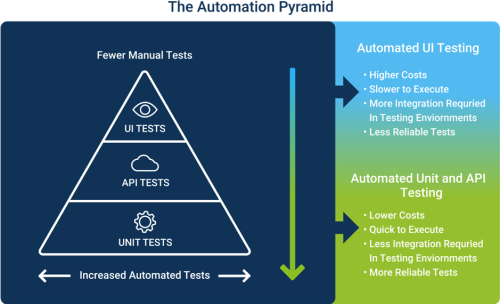
The Test automation pyramid is a guideline for structuring automated tests to achieve fast feedback and maintainable test suites. The pyramid helps us strike the right balance across different levels.
Unit Tests (Base of the Pyramid): These are small, fast tests that check individual components or functions. They form the foundation because they are quick to run and easy to maintain.
Integration Tests (Middle Layer): Integration tests sit in the middle of the Test Automation Pyramid. They focus on verifying that different components of the system work together correctly. Unlike unit tests, which test isolated pieces of code, integration tests check interactions between modules, services, or external systems. Common examples include API tests, Service tests, Database integration, and Third-party integrations.
End-to-End (UI) Tests (Top Layer): These tests simulate real user workflows through the user interface. They provide confidence that the entire system works as expected, but they are slower and more fragile, so we keep them limited to critical paths.
4.4.1.2 Key Principles
- DHI follows the Test Automation Pyramid to guide automation strategy.
- The pyramid model promotes breadth at the bottom and depth at the top – more tests at lower levels, fewer at higher levels.
- Teams should invest more effort in unit and integration tests, and less in UI and end-to-end tests.
- Automation must focus on stability, speed, and maintainability, not on maximising the number of tests.
- All automated tests must be integrated into CI/CD pipelines and run without manual intervention.
- Test results must be visible and actionable, enabling teams to quickly identify failures and take corrective action.
- These principles apply to desktop products, cloud platforms, and shared components, adapted to their architecture.
4.4.1.3 Regression Testing in the Strategy
Regression testing is not a separate layer in the pyramid.
Instead:
- Unit tests catch logic regressions
- Integration tests catch interaction regressions
- Selected UI tests catch workflow regressions This approach ensures strong regression coverage without heavy UI automation.
4.4.1.4 Performance Testing in the Strategy
Performance testing complements the pyramid and focuses on Execution time, Stability and Scalability. It is especially important for Computational engines, Cloud services and Long-running simulations.
Performance tests should be automated where feasible and supported by monitoring.
4.4.1.5 Summary
The Test Automation Pyramid provides DHI with:
- A common automation strategy across all products
- Fast feedback for developers
- Sustainable test maintenance
- Reduced risk of late-stage defects This strategy supports T&I’s long-term software quality goals while respecting the complexity and diversity of its products.